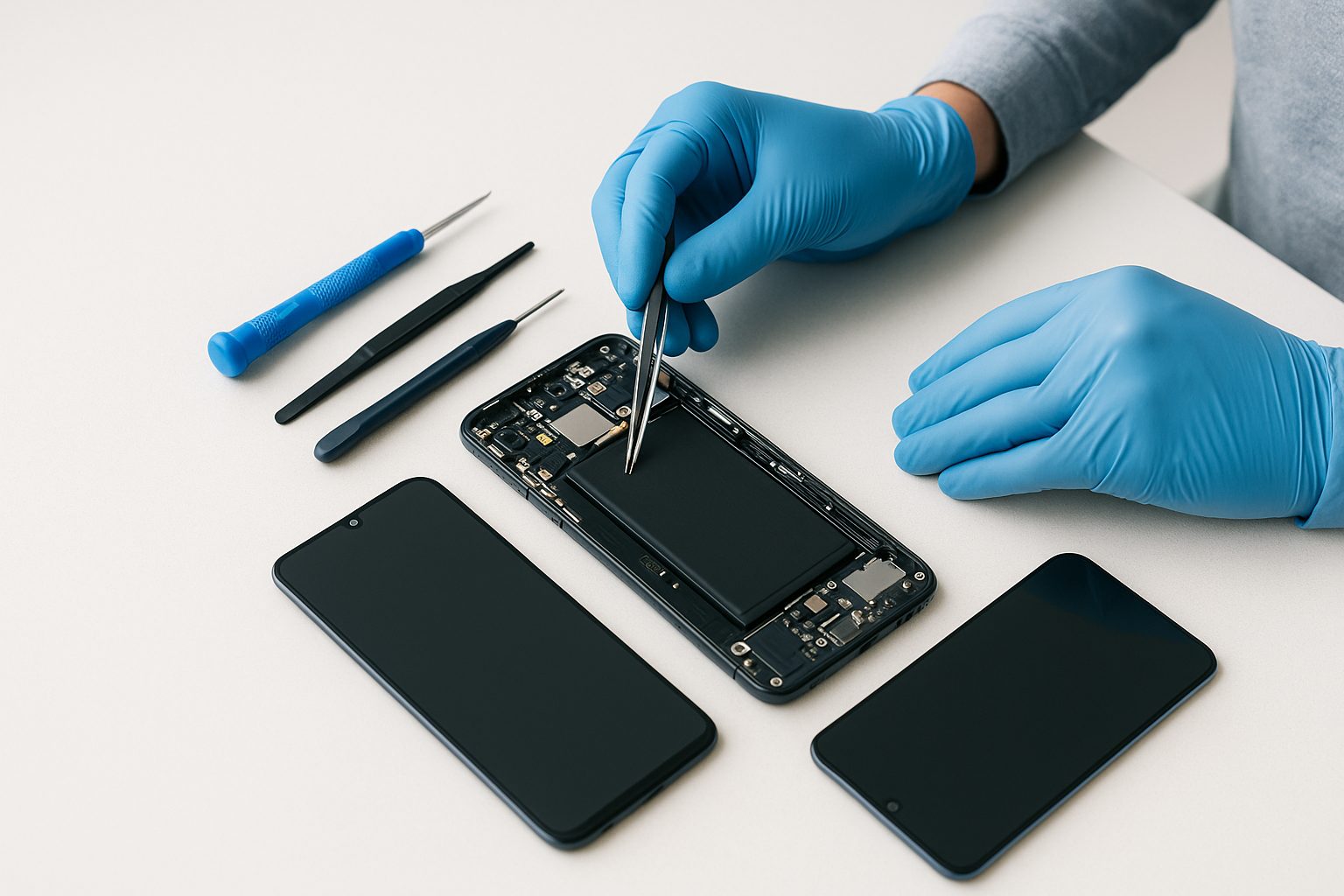
A cracked Galaxy S24 Ultra screen can cost more to replace than some people's monthly rent — we're talking $200–$350 at many shops, depending on the model and part quality. Before you hand your phone to the first place that pops up on Google, it's worth spending five minutes understanding what you're actually paying for, because not all Samsung screen repairs are created equal.
Why Samsung Screen Repairs Vary So Much in Price
Pull up any search for Samsung Galaxy screen repair near me and you'll see quotes all over the map. A Galaxy A14 screen might run $80–$120. A Galaxy S23+ could be $180–$260. An S24 Ultra or a foldable like the Z Fold 6? Budget $280–$400 or more. The model matters, but so does the part.
Samsung uses two types of displays across its lineup:
- AMOLED / Dynamic AMOLED — found on S-series, Z-series, and A5x/A7x models. These screens are thinner, produce richer colors, and are more expensive to source.
- LCD / PLS panels — found on older budget models. Less expensive, but the replacement is also less forgiving if installed carelessly.
A shop quoting you $60 for an S22 screen is almost certainly using a third-party aftermarket panel, not an OEM or Samsung-authorized part. That's not always bad — quality aftermarket screens exist — but you should know what you're getting.
OEM vs. Aftermarket: What the Difference Feels Like
This is the part most repair shops won't explain clearly. Here's the honest breakdown:
OEM (Original Equipment Manufacturer) parts are pulled from Samsung's own supply chain. Colors, brightness, and touch sensitivity will be identical to what you had before. These cost more and are harder for independent shops to source.
High-quality aftermarket screens from reputable suppliers (Incell, OLED copy screens) can look nearly identical to OEM — good brightness, accurate color, responsive touch. For most everyday users, they're perfectly fine.
Low-grade aftermarket screens are where things go wrong: washed-out colors, poor outdoor visibility, touch that registers a half-second late, and a tendency to develop dead spots within a few months.
Ask the shop directly: What brand is the replacement screen? Is it AMOLED or a copy panel? A good shop will answer that without hesitation.
What a Trustworthy Local Repair Shop Actually Does
Price is easy to compare. Process is harder to see. Here's what separates a shop worth trusting from one that just has a good sign:
- They test before and after. Before touching your phone, a reputable tech should check what's working — camera, speakers, face ID, fingerprint sensor — and confirm it's all still working after the screen swap.
- They use proper adhesive and sealing. Samsung phones are designed with specific gaskets and adhesive. A rushed repair can leave gaps that let dust or moisture in.
- They offer a parts-and-labor warranty. Ninety days minimum is reasonable. Some shops offer six months. If a shop won't put a warranty in writing, walk out.
- They're transparent about data. Your personal data should never need to be accessed for a screen repair. A shop that asks for your PIN to "test" the repair should explain exactly why — usually it's to verify Face ID or the fingerprint sensor works, which is legitimate, but you should be comfortable with who you're handing that to.
At iFixForU, with locations across San Gabriel, Alhambra, Rowland Heights, Irvine, and Las Vegas, every Samsung screen repair comes with a warranty and a post-repair function test — and if you're more comfortable discussing the details in Chinese, the staff can help you fully in Mandarin or Cantonese. That matters when you're making a $150–$300 decision.
How Long Should It Take?
Most Galaxy screen repairs — S-series, A-series, standard models — take 60 to 90 minutes in a well-stocked shop. If the display adhesive needs extra curing time, add 15–20 minutes. Foldables (Z Fold, Z Flip) are more involved and may need 2–3 hours or a same-day appointment.
If a shop says "come back in three days" for a Galaxy S23 screen, they probably don't have the part in stock. That's not automatically a dealbreaker — ordering the right part beats using a bad one — but you deserve to know that upfront.
A Real Example: Galaxy S22 Drop in Arcadia
A customer came into an iFixForU location with a Galaxy S22 that had taken a corner drop on a parking structure floor. The glass was shattered and there was a small dark bleed spreading from the bottom — classic signs that the AMOLED panel itself was cracked, not just the protective glass on top. Total repair time: about 75 minutes. The tech confirmed the fingerprint sensor and camera were functioning before and after. Cost was in the $160–$190 range using a quality AMOLED replacement screen, with a 90-day warranty.
Compare that to a mall kiosk quote the customer had gotten for $110 — no mention of part type, no warranty discussed. The $50 difference bought peace of mind and a functioning screen that still looks right six months later.
Questions to Ask Before You Commit
- What brand/grade is the replacement screen — OEM, AMOLED copy, or Incell?
- Do you offer a warranty on parts and labor, and for how long?
- Will you test all functions (touch, cameras, sensors) after the repair?
- How long will it take, and do you have the part in stock today?
Quick Takeaways
- Samsung screen repair prices vary by model and part quality — don't compare prices without knowing what part is being used.
- A quality AMOLED replacement costs more than LCD or low-grade copies, but the difference in daily use is real.
- Always ask about the warranty — 90 days minimum, in writing.
- Repair time for most Galaxy models is 60–90 minutes at a stocked shop.
- Bilingual service matters if you or a family member is more comfortable in Chinese — iFixForU locations in the San Gabriel Valley and beyond offer full Mandarin and Cantonese support.
- Foldables (Z Fold, Z Flip) are more complex — budget more time and ask specifically about that model.
If your Galaxy screen is cracked and you want a straight answer on cost and turnaround before you drive anywhere, book a repair appointment online at iFixForU or give us a call at (626) 800-2030. We'll tell you exactly what part we're using and what it'll cost — no surprises.